
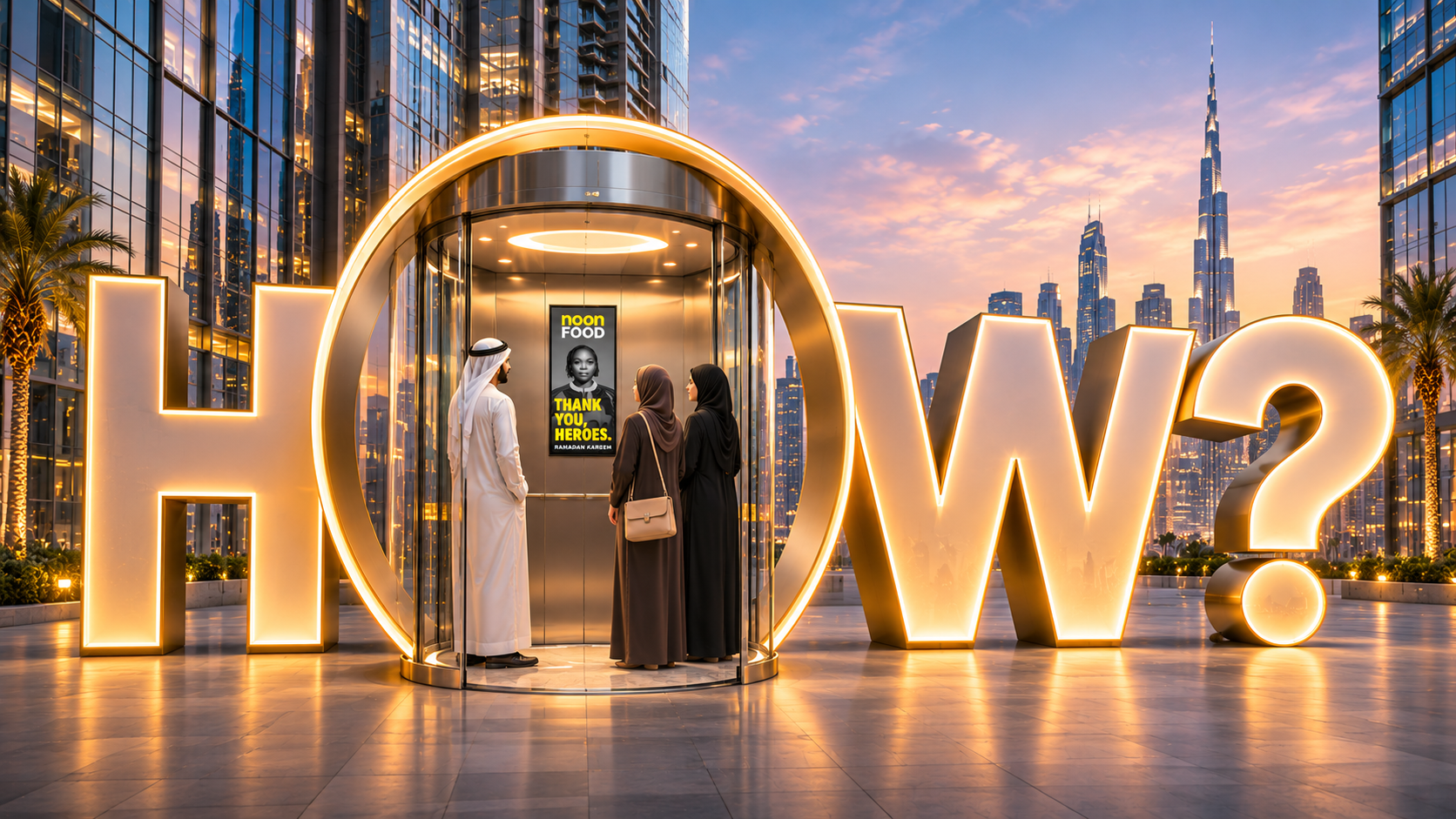
In today’s fragmented advertising landscape, reaching consumers is only part of the challenge. The bigger question is whether each advertising channel contributes something meaningful to the overall campaign.
From social media and search to billboards and Digital Out-of-Home (DOOH), marketers must balance audience reach, exposure frequency, and relevance to build effective media strategies.
In the UAE, where high-rise residential communities and commercial towers shape everyday urban life, elevator media offers an additional opportunity to connect with consumers within their daily routines.
But what does elevator advertising actually contribute to a modern media plan, and how should marketers evaluate its value?
1. Beyond Reach: What Does Elevator Media Add to a Media Plan?
A successful media strategy isn’t necessarily the one with the most channels. It’s the one where each channel serves a clear purpose.
Traditional OOH builds visibility across roads and public spaces. Social media encourages discovery and engagement, while search advertising captures existing consumer intent.
Elevator media extends brand exposure into residential and commercial environments, creating opportunities to reach audiences during recurring daily activities.
For media planners, two considerations are particularly important:
- Incremental Reach: Can the placement reach additional people beyond those already reached through other channels?
- Additional Frequency: Can repeated exposure reinforce brand familiarity among relevant audiences?
Both can support campaign objectives, but neither should be assumed automatically. Measuring incremental reach requires an appropriate cross-channel methodology, while the value of additional frequency depends on the campaign’s goals.
The real question is not simply how many impressions elevator media delivers, but what those impressions contribute to the overall media strategy.
2. Where Elevator Media Fits in the Marketing Funnel
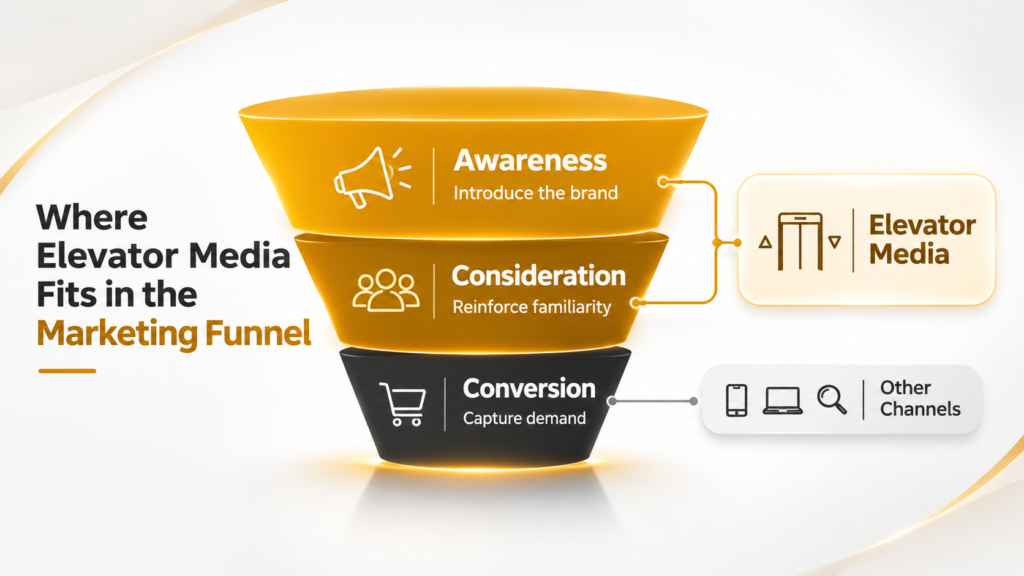
Different advertising channels influence consumers at different stages of their decision-making journey.
Elevator media primarily contributes to two stages:
Awareness: Digital elevator and lobby screens create opportunities to introduce brands, products, and campaigns to audiences within selected residential and commercial buildings.
Consideration: Recurring exposure opportunities can reinforce brand messages and support familiarity over time, particularly when the creative is consistent and relevant.
At the conversion stage, elevator media can complement performance-driven channels such as search, social advertising, and e-commerce.
For example, a consumer may encounter a smartphone advertisement inside an elevator and later search for the product online.
However, exposure alone does not prove that it caused the subsequent action. Establishing that contribution requires suitable attribution or research.
The objective is to create connected brand experiences across channels, rather than expecting every channel to deliver immediate conversions.
3. Residential vs. Commercial: Planning Around Audience Context
One of the strategic advantages of elevator advertising is the ability to select different building environments based on campaign objectives.
Residential Elevator Media
Residential buildings provide opportunities to connect with consumers in their home environments.
This can be relevant for food delivery, e-commerce, consumer electronics, banking, groceries, and home services.
For example, a grocery delivery campaign may benefit from communicating convenience and promotional offers within residential communities.
Commercial Elevator Media
Office towers and commercial developments offer opportunities to reach working professionals and business visitors.
These environments may be relevant for financial services, automotive brands, technology providers, and B2B solutions.
The important consideration is not simply residential versus commercial.
It’s whether the selected buildings align with the target audience, geographic priorities, and intended campaign frequency.
Building type provides useful planning context, but it should not be treated as a substitute for verified audience data.
4. A Practical Example: Planning a Smartphone Launch in the UAE
Consider a smartphone brand preparing to launch a new product across Dubai and Abu Dhabi.
Rather than relying on one advertising channel, the brand could assign different roles across its media mix.
| Advertising Channel | Strategic Role |
| Roadside OOH | Establish broad visibility in key urban locations |
| Elevator Media | Reinforce product messaging within selected residential and commercial buildings |
| Social & Video | Demonstrate features and encourage product discovery |
| Search Advertising | Capture consumers actively researching the product |
| Retail & E-commerce | Support purchase decisions and conversions |
In this scenario, elevator media adds recurring exposure opportunities within everyday environments, while digital channels support engagement and demand capture.
The strategy becomes stronger when the creative messaging, geographic priorities, and campaign timing are coordinated.
The takeaway: A connected media plan is not about adding more channels. It’s about giving every channel a clear role.
5. From Delivery to Outcomes: Measuring DOOH Effectiveness
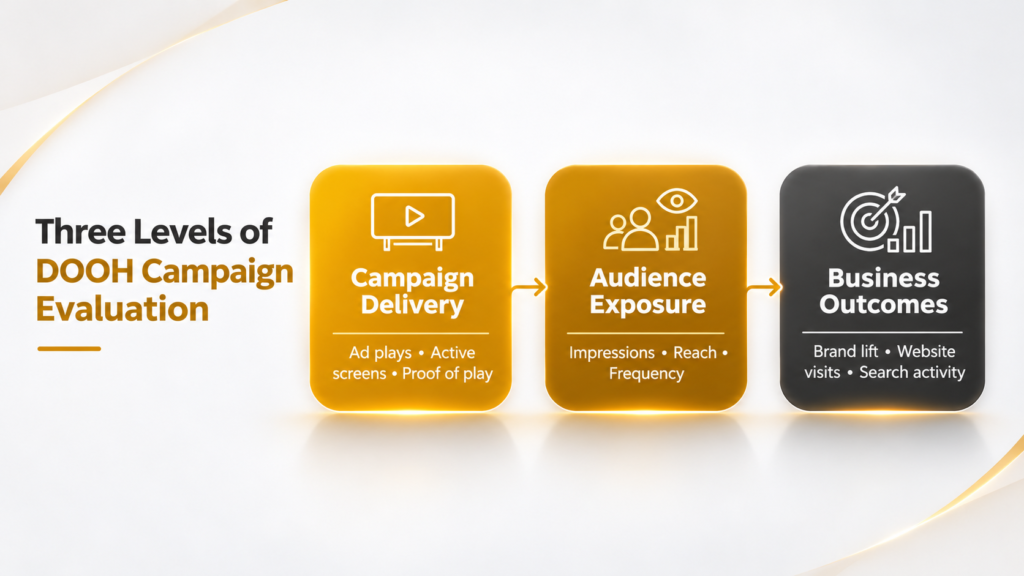
When evaluating elevator advertising, marketers should look beyond screen counts and campaign delivery alone.
A useful measurement framework considers three levels:
1. Campaign Delivery — Did the campaign run as planned?
Evaluate activated screens, completed ad plays, campaign duration, and proof-of-play reporting.
2. Audience Exposure — Who had the opportunity to see the campaign?
Assess estimated impressions, unique reach, average frequency, and geographic distribution, where supported by the available measurement methodology.
3. Business Outcomes — Did the campaign contribute to results?
Depending on the objective and available data, advertisers may examine brand lift, search activity, website engagement, or attributable actions.
These indicators require careful interpretation. For example, increased website traffic during a campaign does not independently establish that DOOH caused the increase.
Effective measurement connects media delivery with audience exposure and, where possible, measurable business outcomes.
6. Focus Media MEA: Building-Based Advertising at Scale
With 6,500+ digital advertising screens across the UAE, Focus Media MEA provides brands with opportunities to connect with audiences across residential and commercial environments.
Its network enables advertisers to plan campaigns across different geographic areas and building types, helping integrate building-based DOOH into broader media strategies.
Through location-based planning, digital campaign execution, and delivery reporting, Focus Media MEA supports brands looking to extend their presence into the spaces consumers use throughout everyday life.
Conclusion: Making Every Touchpoint Count
Modern media planning isn’t about choosing between traditional and digital advertising. It’s about understanding how different channels work together.
Billboards establish visibility across public spaces. Social and search support engagement and intent. Elevator media introduces recurring opportunities for brand exposure within residential and commercial buildings.
For UAE advertisers, its value lies in how effectively these placements complement existing channels, reach relevant audiences, and support measurable campaign objectives.
The most effective media strategy isn’t about being everywhere. It’s about making every touchpoint count.
Build a More Connected Media Strategy
Discover how Focus Media MEA’s elevator and lobby advertising network can complement your next UAE campaign.
Explore Our Advertising Solutions